

For the past five years, much of my leisure readings, learning, and self-development hasn’t been about designing software, building product, and working with product teams. Instead, it’s been about getting babies to sleep through the night, navigating potty training, handling tantrums, and figuring out how to survive as a parent.
As I reflect on this time, I can genuinely say that my growth as a product leader didn’t take a back seat. In fact, it was strengthened through my experience of becoming a mother.
Becoming a parent deeply expanded my capacity for empathy, a vital characteristic for product managers. Before having kids, I had never really needed to empathize with a baby or toddler—how many of us remember what it was like to be one or two years old? Developing empathy at this level changed how I interact with colleagues as well. Even though we aren’t literally dealing with toddlers in the workplace (well, most of the time), we are all human beings with similar needs for respect, compassion, and care.
Here are 10 things I’ve learned as a mom that are just as applicable to product management — and leadership in general.
1. Experiment and build incrementally
No number of parenting books, podcasts, and courses could have fully prepared me for the challenges I would face as a parent. After my first daughter was born, I quickly learned to accept that I could not be a perfect parent. The best thing we could do was to iterate and experiment as the new norm; building a little each day upon what was previously built. And sometimes we had to start over after what we may have previously built didn’t work.
No baby or product is born complete. Babies start scooting before crawling, walking before running. It’s very rare for any product to be done in its first release, neither is this something that should be expected or strived. You wouldn’t expect a kid to become a concert pianist after one piano lesson.
There’s a well-known quote -
“If you are not embarrassed by the first version of your product, you’ve launched too late.” - Reid Hoffman
To me, this does not mean that you should rush to launch a product, but rather, you should not aim to build a product that you believe to be perfect or done before launching. It’s important to ship small increments of value frequently, so you gather more information on how your customers respond to and use every aspect of your product.
Babies don’t start speaking full sentences. They start communicating through gestures and sounds, then words and phrases, before stringing everything together. Every step of the way, they are taking in information about how you respond and react (whether it’s confusion, frustration, surprise, or praise), and they are using these bits of information to figure out their next iteration.
2. Be consistent
I remember being asked while pregnant, ”Who’s going to be the nice parent and who’s going to be the mean one?” And I would respond saying it’s likely I’ll be the strict one. However my partner and I later learned, having different behavior and emotional approaches from different caretakers, like “good cop, bad cop” doesn’t work. It’s very confusing. It’s important there’s alignment across everyone on the approach. This helps children understand how things work and what they can expect from the parents, which brings calm to the chaos.

The same concept applies to product teams. For example, imagine someone from Customer Success (CS) approaches the PM with an issue and asks that it be prioritized. The PM might say they’ll bring it up at the next refinement. But if that same person goes to an engineer who immediately starts working on it, it sends a very different signal: that going directly to engineering, or making enough noise, gets results. This misalignment creates confusion and frustration. Teams need to agree on how to respond and prioritize so other teams clearly understand what to expect. The idea of consistency should extend not just within individual teams, but across the entire product organization. How can product teams align better to create that consistency?
3. Release control and enable others to act
Many toddlers have a strong desire to act independently. I believe kids are naturally curious and evolutionarily wired to assert themselves so they can learn quickly and adapt to survive. This phase can be frustrating. It might take them 20 minutes to put on one shoe, or they may “help” bake cookies only to create a bigger mess. It’s almost always faster and easier to do things yourself, and to do them exactly how you want. But that convenience comes at the cost of their growth and independence in the long run.
As a parent, I’ve had to learn to let go of control and allow my kids to try things, even when it’s messy or time-consuming. I started intentionally finding moments for them to help, even if it slowed me down at first.
I’ve applied this same mindset to my role as a PM. When facing a task, I ask myself, “Is this something I need to do, or can it be a learning opportunity for someone else?” When asked to make a decision, I often respond with, “What would you do? What options have you considered?”
This isn’t about offloading work or avoiding responsibility. It’s about enabling others to think independently and cultivating a culture of ownership, trust, and critical thinking. When people feel empowered to act on their own, they’re more likely to achieve extraordinary outcomes or learn to put on their own shoes.
Another powerful enablement technique is offering choices. Simply declaring “It’s time for bed” can trigger resistance because children, and adults too, naturally crave a sense of control. Instead, you might say, “It’s time for bed. Would you like Mom to help you, or do you want to do it yourself?” Giving people agency helps them feel part of the process. The same principle applies when working with stakeholders, especially when discussing feature priorities.
4. Give recognition by focusing on the effort, rather than the outcome
As a parent, I developed a habit of saying “good job” as a general statement of praise because, of course, I wanted my kids to feel good about their accomplishments. One day, after I absentmindedly said “good job” to my daughter, she asked, “Why?” That question stopped me and made me wonder whether my reaction actually served its purpose. Despite good intentions, researchers caution that constant praise can be counterproductive to building genuine self-esteem. To develop real confidence, children need to learn how to cultivate positive feelings from within.

One way to do this is to focus on the effort rather than the outcome. When we help children reflect on their actions and evaluate whether they’ve met their own goals, they start learning to decide for themselves how they feel about the results. Focusing on the effort might sound like, “You’ve been practicing that song every week for months. It sounds like you’ve really mastered it.” In contrast, a generic statement that lacks specific details about their effort or qualities doesn’t do much to build them up.
Sometimes, a simple observation about what someone did can be more meaningful than a blanket “good job.” It shows that you’ve paid attention to their effort. If you don’t work closely with the person, it can also be a great opportunity to ask about their experience, such as, “What was the hardest part of doing this?” or “How did you come up with the idea?”
5. Validate the emotion
Think back to the last time you saw a child fall or get hurt while playing. What did you or the adults around you say? Maybe someone said, “It’s OK” or “You’re OK!” I remember hearing those words often as a child. I hated it, yet I found myself saying the same thing to my own kids. Recently, I realized why it never felt right. It’s a dismissive phrase that lacks empathy and even contradicts what the child is actually feeling. Imagine sharing a painful experience with your manager and hearing them say, “You’re OK.” It wouldn’t feel very comforting.

Saying “It’s OK” often serves to quiet the display of emotion so that we, the adults, can stop feeling uncomfortable. It prioritizes our need for ease over the other person’s need for support. It also sends an unspoken message that strong emotions are something to avoid—that they make others uncomfortable.
What can we do instead? People need to know that their feelings matter and that they’re being heard. Validation helps us feel accepted and safe. Emotional validation means listening, acknowledging what happened, or reflecting what the person is expressing. For a child who has just fallen, it might sound like, “I saw you fall hard. Are you hurt? Do you need a hug?” For a colleague, it might sound like, “I can tell you’re upset. There’s a lot going on—do you want to talk about it?”

6. Highlight the yes
On the related tune of empathy, rejection and being told “no” can have similar effects on someone’s emotions if it’s dismissive. Hearing “no” again and again as a toddler is no fun. Adults don’t like it either. As PMs we work with limited resources and competing priorities and end up having to say “no” to many stakeholders. This is never easy but it’s something we can get better at doing. Learning how to do this better can not only save relationships, but can also help build them. The next time you’re ready to deny or disagree with a request, try a Yes-No sandwich or “Yes, but not right now” approach.
Here’s what a response to my daughter who wants to spend some time with a friend may sound like “Sounds like you want to play with your friend. You haven’t seen her in a while. You always have a lot of fun with her! We have school today though. Let me call your friend’s mom and see if we can play this weekend.” Essentially this is a “no” but sandwiched between two “yes” responses. A very similar approach can be used with a colleague. “Thanks for bringing this up. Our team has talked about how big this would be for customers. Right now we’re working on a high priority feature to unblock a lot of merchants. This is a great idea to revisit in the future.”

7. Focus on what will deliver the highest impact
What comes to mind when you think about household responsibilities?
Maybe it’s remembering and planning birthdays — not just your kids’, but their friends’, your friends’, relatives’, and their kids’ too. Or it’s planning groceries, setting up playdates, writing thank you notes, buying gifts, remembering school holidays, arranging backup childcare, registering for activities, or simply knowing where things are around the house. These are all examples of unseen tasks that often go unnoticed or unacknowledged. They’re part of what’s called invisible labor, and they often fall on primary caretakers, most often women.
When I think about the role of a PM, which centers on setting context and empowering teams, I see another form of invisible labor — the intangible work that keeps everything running smoothly. As mentioned earlier, one way to manage this is through enablement: helping others take ownership. Another is by focusing on what will create the most impact.
When I was working on overcoming perfectionism, I learned about the “80/200 rule.” I keep a sticky note near my computer that reminds me to ask, “Is this an 80 percent thing or a 200 percent thing?” before I start any task, personal or professional. It’s impossible and unhealthy to do everything perfectly. This question helps me focus on where extra effort truly matters. Sometimes 80 percent is more than enough, and if any of those 80 percent tasks are important enough, others often step in to help fill the gaps.
Adopting this mindset has helped me set boundaries, accept imperfection, focus on meaningful work, and, most importantly, take better care of my mental health.
8. Inject curiosity
Let’s be real, leading is stressful, whether at home or at work. With an endless list of things to do, consider, and be responsible for, it’s easy for anxiety to build up. Dr. Jud Brewer, author of Unwinding Anxiety, explains that anxiety itself is a habit, and one way to break it is by understanding how our mind works. When we start to worry, our brain reinforces the behavior because it gives us the illusion of control or progress. The irony is that worrying actually makes it harder to think clearly and plan effectively. We become less capable thinkers when we’re anxious.

Curiosity, on the other hand, not only feels better than anxiety, it is also fundamentally different. Anxiety feels closed off, while curiosity feels open. Curiosity activates the same reward centers in the brain that light up when we learn or accomplish something. In other words, it can give you a dopamine boost that helps counter feelings of anxiety. One way to manage anxiety is to practice “injecting curiosity” whenever you notice those closed, tense feelings. For example, if you start to feel anxious, try asking yourself: “Where do I feel this anxiety? Is it in my chest or my stomach? On the right or left side? Do other people feel it the same way? What’s interesting about this moment?” The specific answers don’t matter. It’s not about distracting yourself, but about being present, curious, and aware of what sensations you’re experiencing.
9. Always start with the why
What do 4 year olds, product managers, and Backstreet Boys have in common?
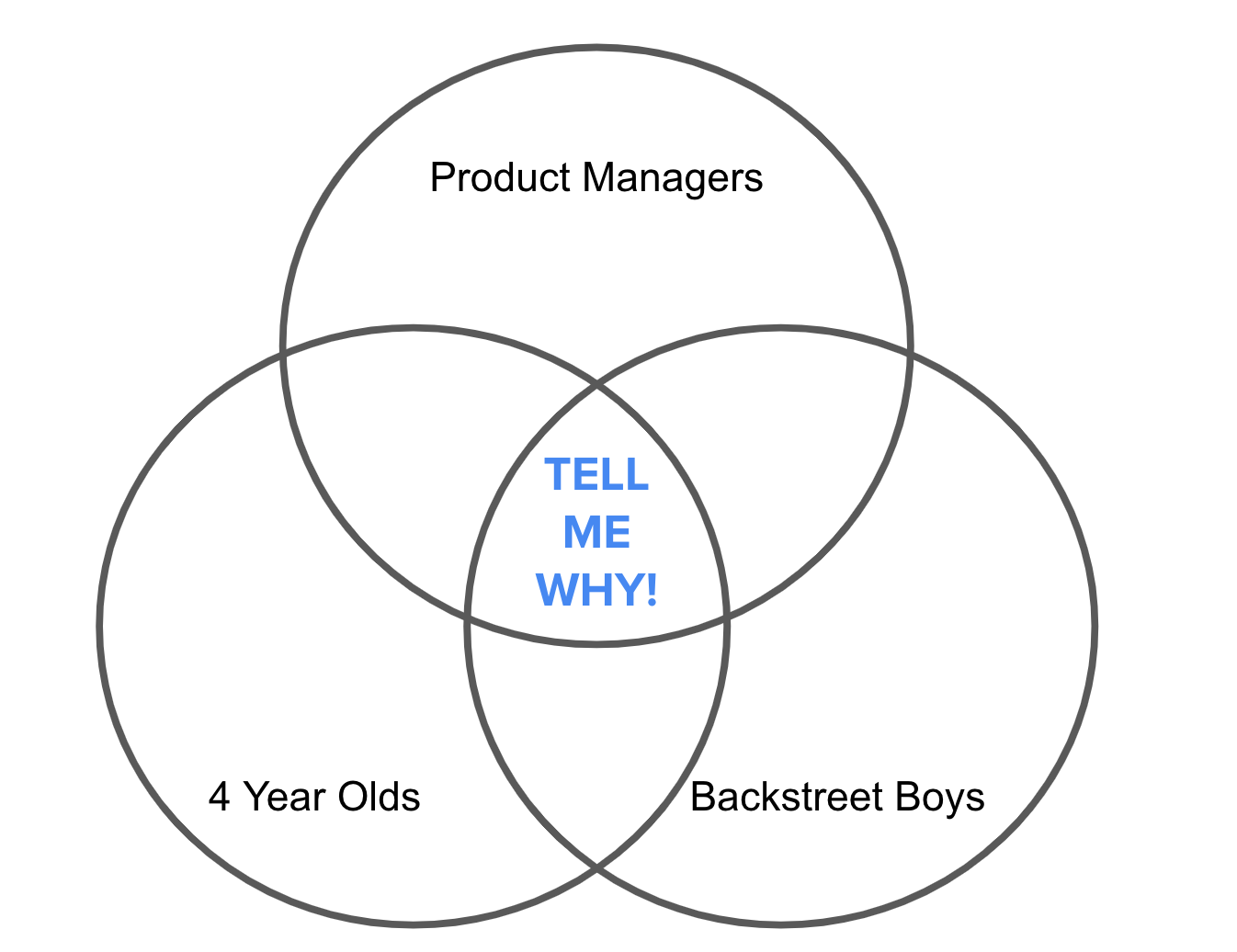
They want people to tell them why. 🙂
Not only should we be asking why, but as Simon Sinek explains, we should start with the “why.” Using his concept of the “Golden Circle,” he illustrates how everyone in an organization knows what they do. Some know how they do it. But very few understand why they do it. By “why,” he doesn’t mean making a profit—that’s just a result. He means the purpose, cause, or belief that drives what you do. Most people think from the outside in, starting with the “what,” while inspired leaders think from the inside out, beginning with the “why.”

Take one of his great examples. This is how Apple’s marketing might sound if they started from the outside in. The “what” is “We make great computers.” The “how” is “They are beautifully designed and easy to use.” Would you feel excited to buy their products?
Now imagine hearing the “why” first and then moving outward: “Everything we do, we believe in challenging the status quo. We believe in thinking differently. The way we challenge the status quo is by making our products beautifully designed and easy to use. We just happen to make great computers.” That is the kind of message that makes people want to buy Apple products.

The Golden Circle also happens to mirror the structure of the brain. The outermost layer, the neocortex, is responsible for rational and analytical thinking and for language. The inner regions, the limbic brain, are associated with our feelings, like trust and loyalty. They also play a key role in human behavior and decision making.

Interestingly, in children, the part of the brain that supports rational thinking is not fully developed until their mid twenties. Unlike adults, they rely much more on the part of the brain that processes emotion.
When you communicate from the outside in, people can understand information like features and benefits, but that alone does not usually move them to act. If you are not clear on why you do what you do, how can you expect anyone to buy from you, advocate for you, or stay loyal? When we speak from the inside out, we connect directly with the part of the brain that shapes feelings and drives behavior.
“People don’t buy what you do; they buy why you do it. If you talk about what you believe, you will attract those who believe what you believe.” - Simon Sinek
10. Lean into the community
As a new mother, it was easy for me to slip into a sense of darkness and solitude. For what felt like forever, I lost track of time as days and nights blurred together. It was tempting to compare myself to the polished images of motherhood I saw everywhere. No one in my social circle had children, and we had no family or support system nearby. Reaching out to other parents, especially strangers, was the last thing I wanted to do.
Eventually, as I started to come up for air, I joined an online support group for local moms. I found thread after thread of honest stories, practical advice, and small “gold nuggets” that answered questions I had been struggling with. I found a flood of helpful resources and a sense of shared understanding I had been missing. If I had taken even a moment to dip into that community earlier, it could have saved me many hours, days, and weeks of heartbreak and desperation.

The pandemic has separated us more than ever. It is easy to slip into silos, but we cannot solve problems alone. You may be the primary person responsible for a product or problem in your area, but there are often many PMs who have faced similar challenges, or even PMs who have led your product before, only a video chat away. At BigCommerce, I made a point of connecting with PMs across the company. I found people working in adjacent areas with similar interests and obstacles, and others who cared about the same metrics or were wrestling with similar questions.
If you ever start to feel alone in a challenge, believe me, as polished as other PMs may seem, they probably do not have everything figured out either. Product management is already a demanding role. Lean on and partner with other PMs, both within your company and outside of it. I was fortunate to work with a diverse group of PMs from many different backgrounds at BigCommerce. Lean into that kind of community not just for yourself, but for the sake of the product.
These are ten learnings from parenting that I have found valuable in my role as a PM. I hope you are able to take something from them. I encourage you to choose one that feels a bit less natural to you and practice it this week.

2018 BigCommerce Product & Engineering Summit
#actwithintegrity #beaccountable #beinclusive #betransparent #makeadifferenceeveryday #thinkbig